


search
date/time

Fri, 4:00AM
overcast clouds
13.6°C
WSW 11mph
overcast clouds
13.6°C
WSW 11mph
 | Sunrise | 6:20AM |
| Sunset | 5:22PM |  |

Steve Whitaker
Features Writer
@stevewhitaker1.bsky.social
P.ublished 30th May 2026
arts
Reasons To Be Cheerful: Lyrical Ballads By Bill Manhire
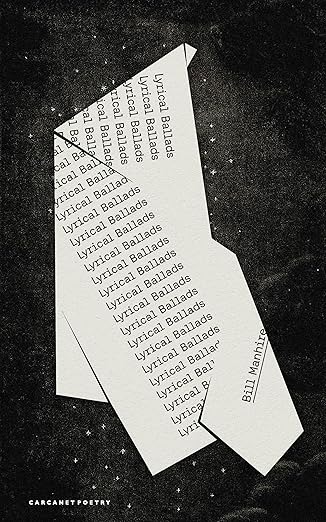
I am reminded of the feeling of odd but gentle dislocation that Aotearea imposes on new visitors, and perhaps that curious but entirely pleasant social disjuncture is a kind of palimpsest of his poetics: though we share a commerce of language and cultural appurtenances with New Zealand, the verisimilitude is a veneer – a look beyond the hinterland reveals a strange but strangely cheerful undercurrent of seizing the day and its attendant absurdities with simple joy. And if our interest is kindled by exposure to this odd but fascinating terrain, then Manhire’s poems invert the premiss, bringing a sense of over-arching normality to the absurd and the weird.
And, frankly, they are a delight to read. The titular understatement of Lyrical Ballads, perhaps a nod to Wordsworth and Coleridge, lends a paradoxical gravitas to intention if only because so much glitters in the process of sifting; repeated reading uncovers narrative byways that remain close to the surface yet decline to yield to scrutiny. What is revealed is a kind of tantalising ellipsis that seems to be a condition of non-disclosure: if, as Carcanet’s blurb suggests, Manhire’s poetics operate on Valery’s lines of a ‘prolonged hesitation between sound and sense’, then the journey is playful, eliciting the unexpected at every diversion. The boondocks are pictured both knowingly and homiletically; conceived with a blindsiding faux-naivety, as simply wrought as his verse is invariably short. The suggestion of post-apocalyptic disorientation in ‘The World About Us’ is mitigated by the elision of salient locators: if the ‘bewildered passers-by’ in this thinly architectured plain cast a nod to an undercurrent of unease, then ‘the sound of children coughing’ is an echo, ‘noises-off’ that shake the poem’s narrator into a sense of déjà vu.
Such brevity is eloquent. The ‘elsewhere’ of ‘Getting There’ is Beckettian in its obscuring of borders, its ironic negation of the purpose it proposes, until visitant figures emerge, intruding upon the terrain with talk of ‘earthquakes, battlefields’. The moment of revelation, a kind of clarity conferred from distance, is a characteristic of Manhire’s oeuvre, and it is profoundly fitting for a poet laureate whose nation is obliged to look outwards; the received effect of his tendency to infer noises in the aether reminds, obscurely, of the matrons of Kent whose china rattled at the vibration of the Flanders’ guns. Nor is the ubiquitous sense of absence a surprise given the emptiness of a sparsely-peopled land: the deliberate mundanity of street names in ‘Back Country’ adds to the titular remoteness, whilst the conditional locators – the unanswered door, the fleeting trees and rivers – are a prelude to the road, and the poem’s, disappearance:
‘A photograph of the farm on Rugby Road.
It used to go all the way to Invercargill.’
Amongst the pauses, the end-stopped lines and short and pithy observational sequences of a deeply idiosyncratic approach, Manhire will sometimes untether the ground that seems otherwise out of reach. Distilling a Rilke-esque intensity of focus into a very brief Orcadian reflection, the poet infuses ‘Skara Brae’ with the beauty of time and aeonic memory:
‘Birch, hazel, willow.
And beside these someone
must once have placed her pillow.’
The poem following, ‘After the Rain’, indulges a momentary sense of escape with a complementary metaphor as a climb onto a rooftop is greeted with a vision of rain:
‘we want to see
where the water
shakes its wings.’
There is a transcendent quality here, and especially elsewhere, a hint of Larkin’s characteristic abandonment to the sea, the sky and the horizon. Disembarking from the ‘cut-price’ urban crowds of Hull, Larkin yet overlays the humdrum home terrain with a mysterious and counter-intuitive beauty. The apparent voltes face amount, in fact, to an act of identification, an act of, albeit profoundly detached, love. And behind the apparently limitless North Sea (Skara Brae, we can almost guess if we don’t know, looks out over a turmoiled ocean, as the road to Invercargill melts into a boundary-less hinterland) lie Manhire’s figures in a landscape, each embodying a token, a social construct, an obscure moment in the narrator’s history, or pure fiction. The neat, and very witty, circularity of ‘27th December’, concludes with a syllogism whose premiss is that since the date is celebrated by people who are not as famous as folk born on other dates, it is a happy coincidence that Jesus was born on the 25th, or ‘he’d have been nobody’. But the preceding septet describes a form of cultural languor that would echo around the bars, the hen-houses and the rabbit-dispatchers of a nameless NZ town in the post-prandial and torpid Christmas of 1954. The symmetry is, of course, perfect – Manhire’s postwar denizens would revel in the understated comedy of the equation.
The poet’s ability to inhabit the language and the thinking of a vanished culture need not compromise the integrity of his powers of suggestion; throughout Lyrical Ballads we remain present, as we occupy, by a kind of mental transference, the purlieus and byways of a world that is congenial but palpably odd: a makeshift Dunedin where storied images blend, where the past conspires with the present, and the moment of recognition ‘between the station and the stars’ is mitigated by an unreliable handle on memory (‘Explaining Dunedin’); or the noisy narrator ‘Bobby Outram’ who resides on a plain of self-direction, declaiming a species of identity into an extraneous vacuum (‘Outram’). The declamation will not be rewarded with an echo because it exists, like the inundated landscape of ‘Walter’s Fish’, in an absolute isolation where help can never arrive. Walter is a Vladimir figure, a cheerful protagonist who flies hopeful into the architecture of his own dream:
‘yes it’s all a bit of a pain
no, can’t complain
anyway, would you like to have this fish’
Manhire’s use of rhyme is often used to embody, or describe, a state of innocence, one device in a subtle armoury that directs the reader towards collusion in a gentle manipulation of perception. For whilst fully immersed in filtered memory and imageries of the surreal, the poet remains ever-cognizant of irony and will sometimes surface from the maelstrom like a seal testing the air. The process gives perspective to the randomness of disordered perception. When not insinuating a corrective volte-face with wit and laconic humour – the ducks shitting on the path in the Botanic Gardens give visceral relief to a prose-poem about ‘Our History lecturer’s’ patrician obsession with language, whilst ‘The End of the World’ forecloses a labile speculation on human continuity and the availability of ‘gorgeous’ mail-order girls with deliciously mundane understatement…
‘The electric toaster keeps me going,
it can do six pieces at once.’
...Manhire can interrupt a surreal conversation between narrator and a personification of the Hanging Gardens of Babylon, with a deft recourse to Peter Reading’s sharp sense of the comedic absurd:
‘I checked my phone.
I was waiting to be given a time
for my interview at the Trim Pork Marketing Board.’ (‘Fancy Dress’)
Trim pork, or pork trim here in the UK, is the offcut stuff that is consigned to the making of sausage meat; it relegates lyricism to grey monosyllables, and it is a productive metaphor for those (select your personal favourite) scapegoats who we might condemn to the grinder, given the will and the political opportunity. The ubiquitous be-fanged undead of ‘Too Many Draculas’ harnesses humour to the purpose of satire, with a long and witty breakdown of imposture, of ‘how dare they?’ intemperance. And the sum of each line’s accretion is an inventory of popular loathing, inveigling perceived threats into every nook and cranny of the body politic. In such a way, Draculas become the scapegoats, driving the good citizenry under:
‘It’s always hit or miss. They blow us all a kiss
then promise to unlock an age of economic bliss.
Too many Draculas, too many Draculas,
all climbing up the waiting list.’
Manhire, adept by now at the studied and entirely tongue-in-cheek desecration of his own corner of the Arts – ‘Also too many Draculas / these days writing poetry’ – is merely continuing a line of manipulation. For many poems, here, entertain the possibility of narrator as artist, poet as actuator, surprising himself with a description of artistic process intra-poem. Making up some of the very best of Lyrical Ballads it is these odd, time-displacing and profoundly knowing enquiries that impose an ironic burden of integrity on the surreal excursions. Or they would if the poet’s hand were not so pliant, his approach not so knowing. If the prose-poem ‘Cronies’ negotiates figures in the fictive distance into the fabric of the narrator’s present, bringing a kind of addendum to the creative backward glance, then ‘Poetry Updates’ is an uprush of refulgent lyricism, washed in the grace of redemption, until the final couplet restores the reader to the notice-board banal of the title, and delivers it in appropriate metrical tandem:
‘And more on this throughout the day
as fresh information comes to hand.’
Manhire’s instinct for self-reflection and for inveigling self as narrator into the fabric of his poems at point of valediction or even post-mortem, is acute: the protagonist/narrator of ‘Hello’ disturbs time and place in a drama of imaginative ambition, where he becomes the fictional cypher of someone else’s novel, the chap who might get the girl, but is erased as undeveloped in a world of artifice, and returned, without ceremony, to the bottle:
‘I stubbed out my cigarette
and then she dumped me.’
But most, in a collection of relentlessly high quality and endless reward, we find beautiful poems like ‘Sand’ in which the grains are those of an egg-timer, measuring the day, measuring creative finitude. Here, the poet conflates the innocence of childhood sleep, and quietus, somehow distilling a narcotic into the final, breathtaking lines:
‘the little children reach and reach
for the last life in the day
and then it is slow dusk
a hose on the lawn
the runner beans running up
into the sky
like a story, like something read
to help us sleep and yet
we are asleep already.'
More information here.
Also by Steve Whitaker...
Review: Peas On Your Knees - A Life In The Poems Of Michael RosenPoem Of The Week: From Cheshire By Kit WrightPoem Of The Week: Among The Talk And The Laughter By Norman MacCaig (1910-1996)Understanding The Stone: The Green Parcel By John ChallisPoem Of The Week: Soirée By Peter Reading (1946-2011)The shortened address for this article is: newspub.uk/01zmh