


search
date/time

Fri, 7:00AM
light rain
15.8°C
WSW 16mph
light rain
15.8°C
WSW 16mph
 | Sunrise | 6:20AM |
| Sunset | 5:22PM |  |

Steve Whitaker
Features Writer
@stevewhitaker1.bsky.social
P.ublished 16th May 2026
arts
Review: Van Gogh: The Immersive Experience In York
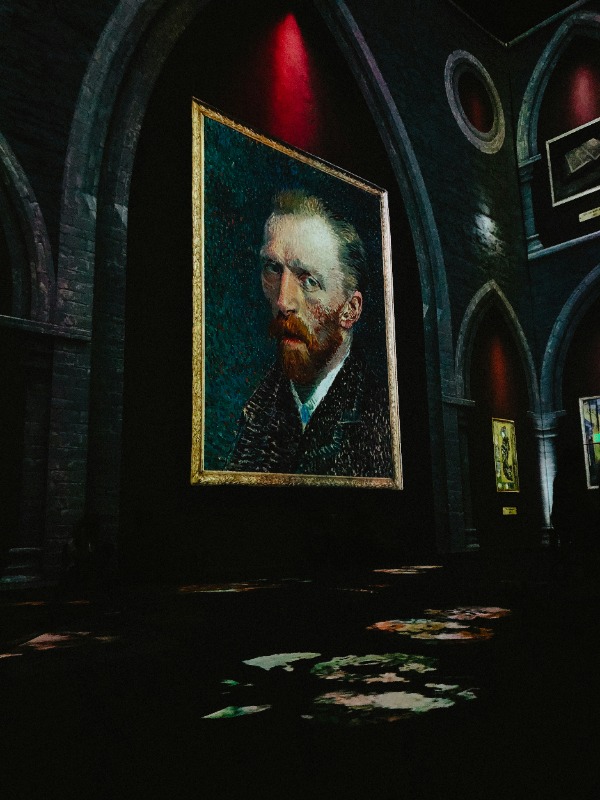
Photo by Janay Peters on Unsplash
Deckchair-bound and wholly absorbed in the multi-media Van Gogh exhibition in York’s deconsecrated St Mary’s church, I found myself recalibrating Richard Curtis’ implied question: what would the artist make of such a radical appropriation of his work? In terms of insight and contextual knowledge – the ‘installation’ gives an organic rendering of art, emotion and life in a continuous heart-bleeding take – Van Gogh’s reaction would be reflexive, necessarily mediated by the shock of exposure.
Even to a modern consciousness that is fully attuned, if not inured, to the unfolding of loop-fed images, the experience is wholly immersive: filmic colours drip down the church’s columns and subtly-insinuated screens, to reveal the rolling, and roiling landscape of Van Gogh’s febrile imagination. The artist’s paintings animate, and melt into each other, describing as they do so, a kind of non-linear trajectory, a fervid, and in places breathtaking, unpacking of motivation, of emotional incontinence and of moments of extreme depression and of its binary, ecstasy. For the tableau embodies no less than the interior workings of Van Gogh’s mind, rendered in the technicolour extremity of his pictures, whose elements pour down the walls and morph into others still more astonishing.
The brilliant superimposition of self-portraiture, one over the other, yields the impression of both the ageing process and artistic continuity, as earlier images fall away like leaves. Van Gogh’s treatment of the natural world is re-envisaged in a continually moving stream of blossom and trees, whose bloom and seasonal shedding surrounds the audience in a maelstrom of change and transience. We are, for an hour or so, an intimate party to the fragile and tempestuous beauty of his imaginings, whose stages are identified with apothegmic subtitles and a resonant voiceover by actor Colm Feore.
Finding darkness in the blinding light of day, Van Gogh’s psychodrama is both endogenous and exogenous, it emerges from within yet is shaped by a unique perception of his surroundings. And it is fitting that the artfully curated accompanying soundscape should describe, in change of tempo and subtle transition between swathing orchestral movement and reflective piano piece, an inner dynamic of intemperate emotion. As the visible manifestations of his tortuous journey unfold all around us in this disused church, we trust, above all, that the artist who sold only one painting during his lifetime would be pleased with the astonishing upturn in his fortunes.
More information here.
Also by Steve Whitaker...
Review: Peas On Your Knees - A Life In The Poems Of Michael RosenPoem Of The Week: From Cheshire By Kit WrightPoem Of The Week: Among The Talk And The Laughter By Norman MacCaig (1910-1996)Understanding The Stone: The Green Parcel By John ChallisPoem Of The Week: Soirée By Peter Reading (1946-2011)The shortened address for this article is: newspub.uk/01zfk