


search
date/time

Sun, 1:00AM
clear sky
8.4°C
WNW 11mph
clear sky
8.4°C
WNW 11mph
 | Sunrise | 6:22AM |
| Sunset | 5:20PM |  |

Steve Whitaker
Features Writer
@stevewhitaker1.bsky.social
P.ublished 10th October 2026
arts
Venus At Midnight: The Amygdala Safari By Carmella de Keyser
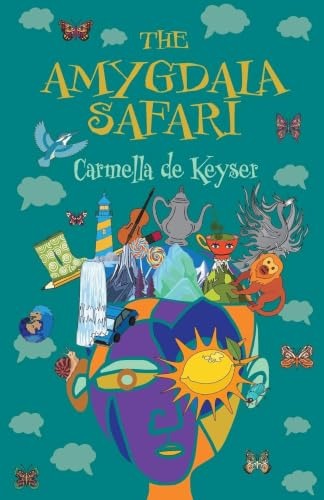
It is fitting that de Keyser’s stated mandate for her new collection of poems, The Amygdala Safari, should focus on growing pains, the pain that attends the pubertal passage between childhood and adulthood, for the anticipatory excitement and utter immediacy of being young is necessarily counterpointed by its (bi)polar opposites of anxiety and fear; a more common and navigable form, no doubt, of the mental extremity that drove the increasingly eccentric Swinburne into seclusion at Putney.
The art of learning and becoming, of engaging with brand new, and often seismic, emotions is served well here, and if Swinburne’s verses were steeped in formal Victorian traditions, de Keyser’s poems are profoundly modern streams of consciousness punctuated by ad hoc voltes face, mid-flight self-correctives. and a neat line in rhymes of reinforcement that work better for being isolated. The free flow of ideas and associations is reflective of juvenile naivety but wrought in metaphorical complexity. If the received effect is deliberately staccato, then the glittering range of ideas and figures ironises the innocence of the rendering, in an act of multi-layered, but somehow not intractable, contemplation. The beguiling quiet of ‘Floating City’ condenses an urban idyll into a landscape, as though dreams were still possible in our upended reality of peace’s obverse:
‘This society dreams as it floats.
There are smart, vertical cities in the sky.
We cherish goals, and we treasure life.’
It is possible to imagine the ‘vertical cities’ of de Keyser’s teleological vision inhabited by Martin Amis’ ‘air people’, the insect-like denizens who never leave apartment blocks except to cross the street to re-ascend, in this half-dystopian paradise. The hope is double-edged, like a teenager’s sense of becoming. De Keyser’s extraordinary instinct for both insight and identification often emerges in isolated asides whose truth is most effectively delivered without lyrical ornament:
‘Yet now he is the extraordinary beauty one can only find in
once broken things.’ (‘A Titanium Phoenix Rising’)
This poem, itself extraordinary, is a bravura homage to those children who struggle, yet transcend, physical disability thereby overturning the very notion of limitation: rendered, initially, in rollicking onomatopoeias of freedom and movement, the young man’s zest is in no way compromised, or delimited, by his condition, confirming the veracity of the narrator’s earlier axiom:
‘He is the magnanimous roar of a wounded lion who has
emerged, stronger than before,
Who oversees his sugar-white rock in duty, humility’.
Electricity animates de Keyser’s clusters of images with preposterous efficiency. Unstill, impelled by unseen hands, inhabiting the personae of children who sometimes seek to run before they can walk, her narrator(s) remain a prey to dreamscapes and to the kind of focus that finds an outlet in the narcosis of repetition, as though the entire world might be construed in the minimalist simplicity of a single word. The poem ‘Green’ finds meaning in microcosm through the medium of sensory perception, as a child might. Here, ‘green’, in its various sensory dispositions, is, at once, ‘alleviative’, palliative, stimulating and comforting, and it leads, if we are fortunate, to an epiphany of renewal:
‘Singing a soft rebellion,
Upwards from the alchemy of the dirt earth.
In green – equality becomes us.
The balance of peace is green.’
It is easy to infer, in de Keyser’s simulation of the unsullied freshness of the juvenile mind, an unspoken homage to the germination of creativity: aside from attempting to remove the sting of nascent emotional turmoil, the poet, in her seductive use of metaphor and simile, weighs the value of the imagination to development, as a means of self-recovery. By this light, the narrator becomes the child’s creative impulse. The two – instinctive creativity and problem resolution - run coterminous in the eloquent diptych, ‘The Worry Box’, whose immersion in the mythologies of Mayan culture opens on to the possibility of resolving personal ‘crises’, as if a shape-shifting spirit guide were on hand to negotiate a passage through a welter of real and imagined fears. Here, the anthropomorphised narrator leavens the ground for the nervous school child later in the poem:
‘In Peru, I am a figure etched in clay and a matching mirror,
Speak to my reflection as you tell of your sorrows…’
But it is to de Keyser’s vision, as much as to the homiletic tone of her book, that we return with enthusiasm. For the more serious purpose, embellished as it is with the inclusion of a useful addendum in which the child is free to explore their own feelings, is wholly reinforced by the sheer positivity of her poems. Energetic, contagious and effervescently wrought, they seduce as they encourage complicity in the sensitive imagination. Towards the end of the ‘safari’, we discover ‘Venus at Midnight’, a closely-observed poem with the distilled poise of a sonnet, and one eye focussed intently on the cosmos as it unfolds before the awed gaze of a child:
‘And each night, I stayed up late to wait and see the evening star.
She lit up the obsidian sky with an unblinking eye from afar.
Oh, how my worries waned and grew dimmer in the twilight,
As I looked at Venus, on those starry diamante studded nights!
More information here.
Also by Steve Whitaker...
Poem Of The Week: Facing The Music By Mairéad ByrneReview: Peas On Your Knees - A Life In The Poems Of Michael RosenPoem Of The Week: From Cheshire By Kit WrightPoem Of The Week: Among The Talk And The Laughter By Norman MacCaig (1910-1996)Understanding The Stone: The Green Parcel By John ChallisThe shortened address for this article is: newspub.uk/02183