


search
date/time

Tue, 1:00AM
broken clouds
16.4°C
WSW 8mph
broken clouds
16.4°C
WSW 8mph
 | Sunrise | 6:12AM |
| Sunset | 5:32PM |  |
P.ublished 5th October 2026
frontpage
The Sun Rose From The West
A Century Ago, London's First Purpose-Built Mosque Opened Its Doors In Southfields. Its Founding Vision Of Peace, Refuge And Welcome Still Stands
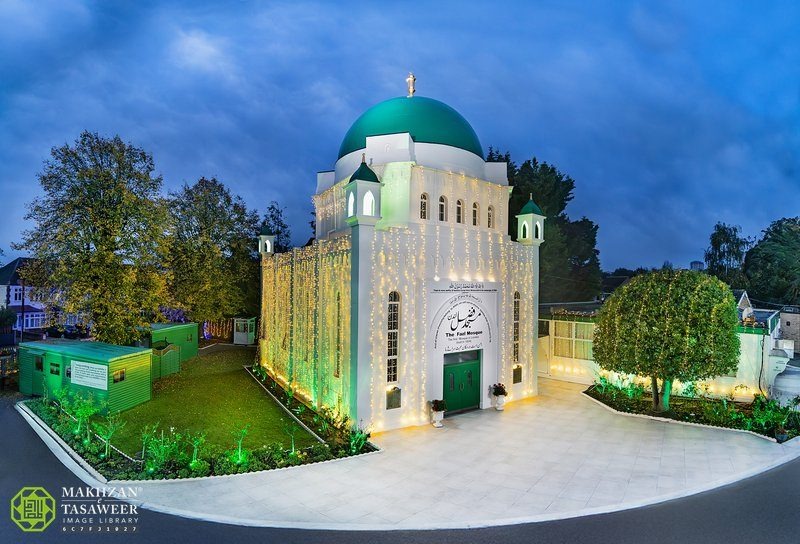
Fazl Mosque
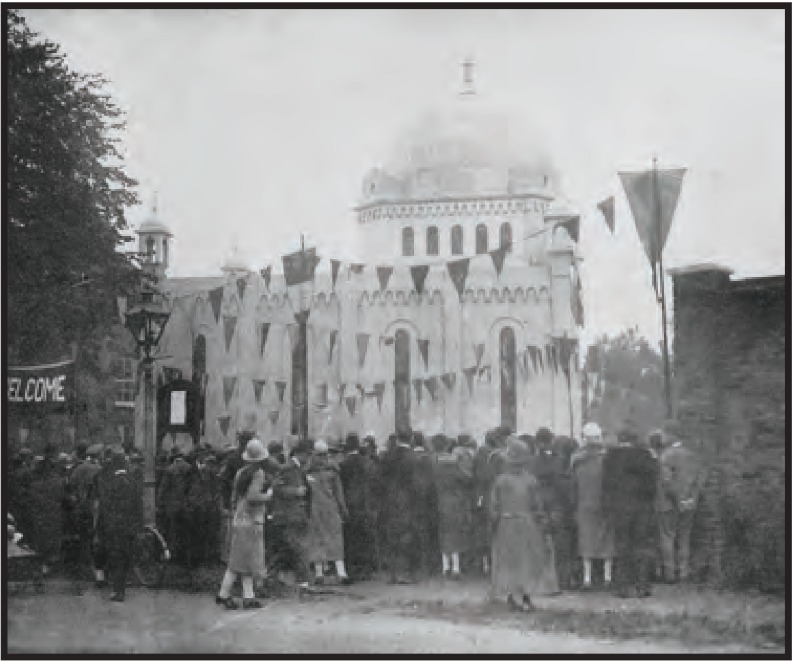
Something remarkable was taking place on Melrose Road SW18. Outside a newly constructed building, people of different colours, nations, cultures and faiths were gathering.
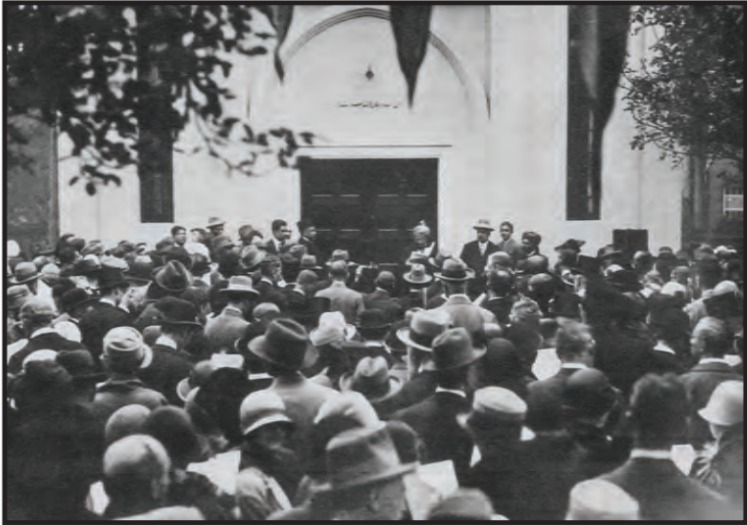
The horizon was filled with English hats and Indian turbans, Arab veils and Persian caps; there were dignitaries, scholars, journalists, neighbours and ordinary men and women. Some had travelled from far beyond Britain; others had come from the streets surrounding the unusual building.
They had come together for the inauguration of the London Mosque, the first purpose-built mosque in London and only the second in Britain, an extraordinary moment not only for the history of Islam but also for Britain itself.
The mosque before them was itself a meeting of worlds. Designed by the English architect Thomas Hayton Mawson of Lancashire, its architecture incorporated influences from the Indian subcontinent while remaining firmly rooted in suburban London. Set into the stone of its façade was a message expressing the purpose for which it had been built: “… and may He make it for ever and ever a centre for promulgating the views of purity, piety, justice and love, and may this place prove a sun of spiritual light radiating forth in this country and in all the countries around...”
Yet those present could not have known what the London Mosque would come to represent over the century that followed. History would put its purpose to the test. Could the mosque become more than a place of worship? Could it become a place where people of different nations, cultures and faiths could meet without fear; where difference did not have to become division; and where the Islamic ideals of peace, justice, love and tolerance could move beyond words and become a lived reality?
A century later, that question is no longer merely theoretical. The building is still standing, now recognised as a Grade II listed building. And so is the vision.
This mosque, and the vision expressed within it, arose from the faith and sacrifice of the Ahmadiyya Muslim Community. An Ahmadi Muslim is taught that the purpose of life is to fulfil the rights owed to the Creator and to fulfil the rights owed to His creation.
And perhaps the clearest way to understand a belief is not simply to hear it explained, but to witness what people are willing to sacrifice for it.
From the purchase of the land to the completion of the building, the London Mosque was funded by members of the Ahmadiyya Muslim Community, who lived thousands of miles away in British India. Among its contributors were ordinary Indian women, many of them homemakers without any source of income. For many, the sacrifice meant selling their jewellery and parting with possessions of personal value to contribute towards a mosque in a distant land, a building they might never see, and a project whose benefits they might never live to witness.
Think about that for a moment. What would make a woman part with something precious to her, not for herself, her family, or recognition?
The sacrifices of these women became part of the very foundations of the mosque, a tangible reminder that, in the Ahmadiyya understanding of Islam, spiritual excellence is not the preserve of one gender.
The mosque's doors would go on to witness moments of political history. In 1933, Muhammad Ali Jinnah, who would later become the founder of Pakistan, returned to the London Mosque and spoke of the influence of the Imam’s eloquence upon his decision to take up the struggle for India’s independence, describing it as leaving him with “no escape".
Its doors would also become a refuge in a time of war. During the Second World War, as London endured the Blitz, the mosque became a place of safety for residents seeking shelter from the devastation around them.
In the decades that followed, its halls would receive presidents, prime ministers, members of parliament and statesmen from around the world. And when an unimaginable crisis struck, the mosque once again opened itself to humanity, serving as a pop-up vaccination clinic during the COVID-19 pandemic.
1984 marked another historic chapter in the story of this place of worship. Following the migration of Hazrat Mirza Tahir Ahmad to the United Kingdom, the London Mosque became the residence and international centre of the spiritual head of the worldwide Ahmadiyya Muslim Community, a place from which guidance would reach communities across the world.
Through the words and actions of Hazrat Mirza Tahir Ahmad and later Hazrat Mirza Masroor Ahmad, the London Mosque became a place from which the teachings of love, tolerance and justice were articulated to audiences across the world. These walls have witnessed not merely history being recorded, but history being made.
From writing World Crisis and the Pathway to Peace to meeting people from every walk of life; from visiting Capitol Hill, UNESCO and the British Parliament to delivering keynote addresses; from receiving dignitaries, leaders and the Archbishop of Canterbury to offering guidance on the challenges facing humanity, the mosque became a stage from which its message reached far beyond London.
And yet, amid all these historic moments, its most profound scenes may be the simplest: the daily five prayers, led by the worldwide head of the Ahmadiyya Muslim Community. This practice shows that humanity can truly fulfil the rights of mankind when it recognises the One Creator to whom we are all accountable.
And perhaps it is fitting that, after all these years, we return to where the story began. In 1926, people of different races, nations and faiths walked towards the London Mosque beneath a banner that simply welcomed them. It was more than an invitation to enter a building. It expressed a fundamental belief: that people of different cultures, backgrounds and religions could live together in mutual respect and understanding.
A century later, that message carries a different weight. Britain, like much of the world, continues to wrestle with questions of division, intolerance, prejudice and mistrust. The Prophet of Islam taught that differences within a society can be a source of strength. Without tolerance, however, those same differences can become a source of division.
On Saturday, 3 October 2026, the doors of the London Mosque opened once again as people gathered to mark a century of its existence. It will be an occasion to express gratitude to the One Creator without any material objective, to remember the purpose for which this place was built, and to reflect on the responsibilities we share as human beings.
A century ago, people entered these doors wondering what this mosque might become. A hundred years later, the question has changed. Perhaps the question is no longer what the London Mosque can become, but what its story asks of us.
Can we build societies where difference does not become division? Can a place of worship become a place of refuge, dialogue and compassion? And can the ideals written into the foundations of a building become realities beyond its walls?
The answer to those questions will not be written in stone. It will be written by us. And so, after one hundred years, the doors of the London Mosque open once again. Perhaps the invitation remains the same. Welcome.
(The centenary event was also hosted at Darul Aman Mosque in Manchester, allowing those who were unable to travel to London to gather and mark this historic occasion together.)
The shortened address for this article is: newspub.uk/0215x