


search
date/time

Fri, 10:00AM
light rain
16.0°C
SW 11mph
light rain
16.0°C
SW 11mph
 | Sunrise | 6:20AM |
| Sunset | 5:22PM |  |

Andrew Palmer
Group Editor
P.ublished 15th August 2026
arts
In That Pen There Is Great Power — Hannah Khalil On Writing The Farmer's Wife
A play born from a memoir, a hundred conversations, and one line that refused to be cut
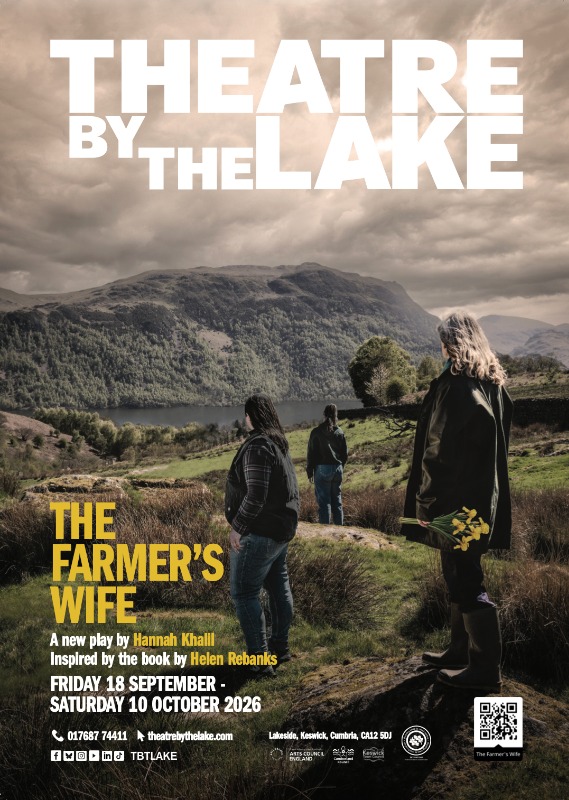
The Farmer's Wife Artwork by Joanne Coates©
That distinction matters more than it might first appear, because the play that has emerged – a world premiere opening at Theatre by the Lake this autumn, staged in the round with an all-female-led creative team and a cast of three actresses – is not, Khalil is at pains to clarify, an adaptation.
"It's a play that's inspired by her memoir," she says of Helen Rebanks. "So, Helen isn't a character in the play." When the two women first met, they agreed on the shape of the thing together: Khalil would take the themes and the ideas of the memoir, but she would also go out and meet, as she puts it, "loads and loads and loads of other women in farming." - interviewing them, gathering their voices, building something plural rather than singular. Helen, she says, was enthusiastic about that from the start.
 (c) Richard Saker.jpeg)
Hannah Khalil
Photo: Richard Saker©
 Joanne Coates .jpeg)
Helen Rebanks
Photo: Joanne Coates©
"A lot of the women I spoke to were really entrepreneurial and very adaptable and able to think about ways of making the farm work," she says. One family had started keeping goats, making their own cheese and milk. "I found that really inspiring. Often when you read the headlines about farming, it can feel a bit depressing – but I felt incredibly inspired by these women and their ability to be creative and forward-looking and adaptable."
Three women, one day
"Having a day gives a sort of clock to the proceedings," she explains. "We're preparing through the day for an event that's happening later on – we don't know at the beginning what that event is, but we know it's important. Our characters keep getting interrupted in their task to prepare for it by farm life, by things that need to happen." It is, she says simply, "quite a good engine to drive the play along."
There's a lovely piece of alchemy buried in how the play begins. Reading Helen's memoir, one passage leapt off the page at her – a stream-of-consciousness list of all the jobs still waiting to be done. "I said to myself, I'm having that.' That's definitely got to live in the play." For a long time, she wasn't sure what form it should take – a song, a monologue, or something else entirely. It became a monologue and quickly turned into her anchor for the whole piece. The play now opens with it: the only words in The Farmer's Wife that are entirely Helen's own, before the audience is carried into the story Khalil imagined around her.
Ten years ago, Theatre by the Lake premiered A Shepherd's Life, adapted from James Rebanks' bestselling memoir of Cumbrian hill farming. The Farmer's Wife, drawn from the memoir of his wife Helen, arrives as a kind of companion piece – though Khalil is emphatic it isn't a reply. Where James Rebanks' book made the case for a way of farming under threat, Helen's turns the lens onto the women who have long sustained that life from inside the farmhouse, largely uncredited. Two memoirs from the same kitchen table, a decade and one stage apart – and, in Khalil's telling, two stories that simply happen to sit side by side, each standing entirely
"Of course I know James's work," she says, "but it's really exciting to be celebrating the hidden female labour in farming, often hidden. It's absolutely not a response to A Shepherd's Life. It's its own thing that exists on its own terms, in the same way that Helen's book does as well."
Writing landscape without showing it
That's freed the play and its design to work symbolically rather than literally. Khalil describes it moving between straightforward, grounded conversation and what she calls "magical memory moments" – sequences out on the farm that are staged not as documentary but as metaphor. "If you want to watch a documentary about farming, you can see sheep being born and so on," she says.
"On stage, keeping that symbolic and employing the audience's imagination, inviting them into the theatrical game – that's what theatre does really well, in my opinion. I hope some of that excites an audience. But it's all grounded through really truthful family relationships, and concerns, and conversations, and arguments."
.jpeg)
Liz Stevenson, director
How she actually writes
New characters and their stories, meanwhile, arrive almost by instinct rather than plan. If someone she's interviewing mentions a concern or tells her a story that grabs her, she knows she wants it in. The work after that is compositional: whose story does it belong to, and how does it find its way into a scene dramatically? "I don't think about it in that way," she says, of the process itself. "That's sort of what happens."
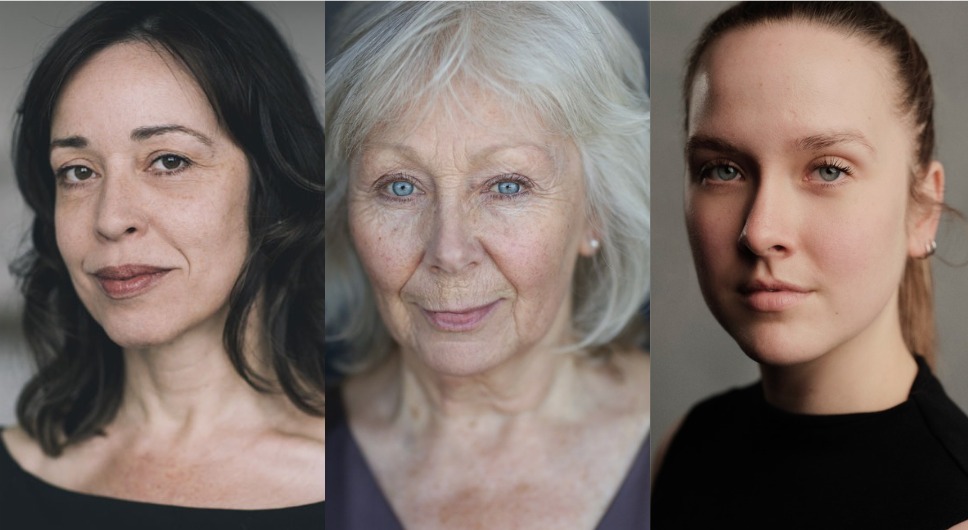
(L-R) Christine Entwisle, Roberta Kerr, Eireann Devlin
Theatre by the Lake has announced a trio of actresses to play the play's three generations of farming women. Christine Entwisle, a West Cumbrian actress and writer with credits at the Royal Shakespeare Company and the Royal Court, joins Roberta Kerr, familiar to millions from long-running roles in Coronation Street and Emmerdale, and Eireann Devlin, another Cumbrian native known for CBBC's The Dumping Ground, who was herself recognised by the Women's Prize for Playwriting last year for a script exploring rural life. The casting of Entwisle and Devlin in particular underlines the theatre's stated commitment to championing homegrown Cumbrian talent – actresses who, in Khalil's words about the women who inspired the play, may well recognise their own families in the script.
Looking back across a body of work that runs from Plan D to Scenes from 68 Years to Hakawatis and now this, she refuses the easy move of disowning her earlier plays. "There are some things I wrote that I look back on and think they're not as good as some of the others — but I wouldn't change any of them. They all represent me at different points in my life, my writing journey, and learning how to put things on stage. Even the ones I feel are less perfect than the others — I love them like my children."
The sign-off
She's speaking, she mentions, from a writers' retreat, in the company of her fellow Bristol Old Vic writers in residence. "I'm in awe of all of them," she says. "They're courageous. Writing is an incredibly courageous act, and I have great admiration for other writers." And then, the line that will stay with anyone who hears it: "Just be brave, and know that in that pen there is great power. Use it wisely."
It's a fitting note for a writer who spent a year listening to women whose labour rarely makes the headlines and who has spun that listening into a play that refuses to flatten them into either victims or saints – women who are, in her own account, entrepreneurial, adaptable, funny, and quietly extraordinary. Khalil didn't come to The Farmer's Wife as an outsider looking in. She came to it, in the end, as someone who recognised her own grandmothers in every farmhouse kitchen she sat in – and who has, with evident care, given them the stage.
Also by Andrew Palmer...
Rank's Gong To Sound Again On Hull's WaterfrontClassical Music: Ralph Vaughan Williams From Ursula, With LoveClassical Music: Granville Bantock Orchestral WorksClassical Music: Franck Quintet Enescu OctetClassical Music: Requiem Da Camera, For St Cecilia & In Terra Pax The shortened address for this article is: newspub.uk/020hg