


fiction
Epistle Of A Sociopathic Vicar - Episode 1
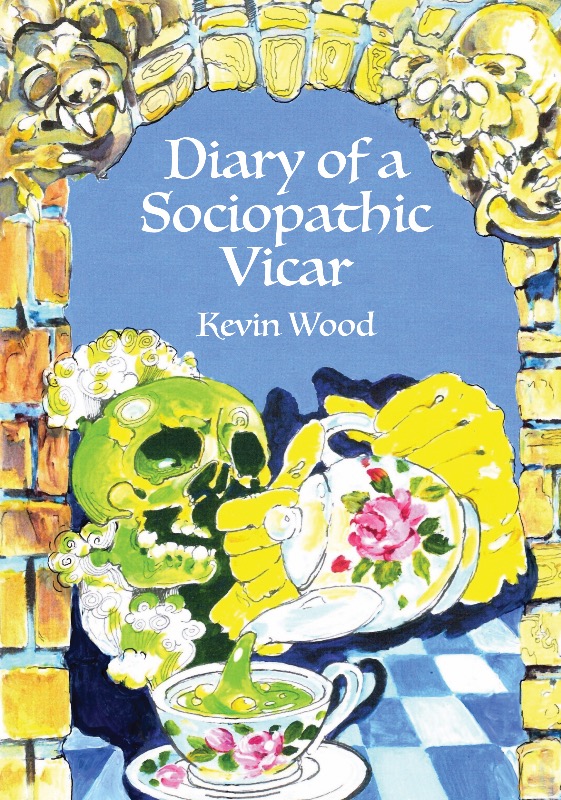
‘Diary of a Sociopathic Vicar’ cover © Michael Huggins
“Saint James Vicarage, David Wilson speaking”.
“Vicar, there’s a problem in the crypt.”
This is a telephone conversation that most people can evade their entire lives. I checked my watch. It was twenty to twelve. Naturally, it was Friday. The Thirteenth.
“Who is this, please?”
“It’s Mike. Mike Neame.”
Mike Neame, church treasurer; suffered the unusual complaint of being competent – unlike his predecessor, who I had caught embezzling church funds.
“What is the nature of the problem?”
“I think it’s better that I show you.”
“When would you like to show me?”
“Anytime.”
“I’m free at the moment.”
“Are you sure?”
“Well, tomorrow I have an important meeting, the consequences of which will occupy the rest of my day, then Sunday does tend to engage me somewhat. I am assuming that this is urgent, or you would not have called me at this time.”
“Um, OK, I’ll drive straight over.”
Of course, having been married so recently that my newly acquired wife, Mabel and I still hadn’t finished writing thank-you letters for all the wedding presents there were other things that I would rather be doing. Yet two important points here should be mentioned.
The first is that being a vicar is a 24/7 job, whatever some may believe. This means that if a parochial matter arises you need a strong argument to put the matter off.
The second is that being prepared to leap into action at a moment’s notice, even at an inconvenient time is noticed. Especially by the person foolish enough to call at this time of night. To my mind, this can only be positive.
“I’ve just got to pop over to the church,” I called up the stairs to Mabel as I pulled on my coat.
“At this time?”
“We serve as we are called,” I replied, knowing that this would sit well with my somewhat evangelical wife.
“I’ll wait up for you, then.”
“I’ll probably be an hour.”
“That’s alright.”
I left the Vicarage, and walked down the path to the church. A dry-stone wall separated the Vicarage from the churchyard. I opened the little wooden gate, stepped through and closed it behind me.
For a moment I considered the new church that was almost complete now. Unusually, it had a dome, making it look somewhat Italian. Even more unusually for a new build church, it was aesthetically pleasing, and functional. When the old church had burnt down as a consequence of the previous treasurer’s embezzlement, the new building had been designed by a member of the congregation who was conveniently an award-winning architect. Thus, it did not look like a used car showroom. The downside of this was that he had added a number of extra features which were not included in the original plans, such as a crypt and secret passages. He had thing about secret passages.
A car pulled up on the road outside, and Mike got out, locking his car as he walked through the lychgate.
I met him at the church doors and asked, “What is this about?”
“Well, Porker…” he said, his voice trailing off.
Porker was a local Hells Angel, and a talented forger. As a strong believer in inclusivity, I had found uses for his talent on a number of occasions. Now not only was he a member of congregation, but also he had painted the inside of the dome of the new church in a Renaissance style. My view is that if you want your church to be inclusive, you can’t choose who you include. It is a point on which I disagree with a number of the Church’s hierarchy.
“If this involves Porker, would it be useful to have him here?”
“Um, won’t he be in bed?”
“As far as Porker is concerned, sunrise marks the end of the day, not the beginning,” I said, taking out my phone.
A few moments later, Porker answered my call.”
“Hi David.”
“Ah, Porker, could you spare me a little of your time?”
“Sure.”
“Can you meet me in the crypt at church, oh, as soon as you can get here?”
There was a pause, and he said, “You know what day it is, right?”
“Yes, it’s Friday.”
“The thirteenth. And you want me to meet you in the crypt at midnight on Friday the thirteenth.”
“Technically, at midnight, it will be the fourteenth.”
There was a coarse laugh, and he said, “Sure, I’ll be right over. Any zombie tries to eat my brains, I’ll knock it into next week.”
I thought about the church council for a moment, but just said, “I’ll see you in a few minutes, then.”
I am aware that on occasion bad things have happened in church crypts – to my certain knowledge a group of heretical cultists had recently beaten each other to death with candlesticks in the crypt of the cathedral – but such occurrences are rare, and the church takes great care not to publicise such matters.
I unlocked the church door, and turned on enough of the lights so that we could see where we were going. I led Mike into the carefully proportioned nave of the church. We crossed under the dome, and I looked up, although Porker’s artwork was hidden in gloom. A pity; it was truly an amazing piece of work, with Jesus in Glory at the top, with attendant saints and angels while towards the bottom were scenes of Hell. In between people either ascended to Heaven, or descended to Hell.
There were some little touches that Porker described as “Easter Eggs”, such as the angels attending Jesus bore a remarkable resemblance to Porker, and two other Hells Angels, Al, and Psycho. At the base of the Western side, the not very Reverend Graham Walters was having a blazing church warden’s stave applied in a fashion to make the eyes water. This was not unreasonable as he had used such an implement to murder the parish’s Lay Reader, Mordred Williams for writing a book on how to survive alien abduction.
Despite being a particularly ineffective Lay Reader, Mordred was now immortalised as one of the saints sitting at the feet of Jesus. This, as Porker had pointed out, is very traditional in such paintings. Other people of note within the parish featured, such as Douglas the architect, but at my most firm insistence I did not. For me to appear in such a fashion would be viewed as conceited at best, which it not the perception that a vicar should cultivate.
We passed the spot where the unfortunate Bishop’s Chaplain, Wendy, had concluded her Earthly existence by plummeting from the top of the dome[1]. On the far side of the dome we descended the stairs into the crypt, turning on the lights as we went. Around the sides of the crypt were numerous square openings for people to be interred.
“And what is the problem?” I asked Mike.
“The tombs.”
I repressed a sigh. “In what way are the tombs a problem?”
“Well, you know how we’re selling off the tombs so that people can be interred?”
I nodded. It was an obvious – and traditional – practice. We sold the right to be interred in one of the tombs for £5000. Some of that went in legal fees, of course, but on the whole it was looking like a good source of income. Considering that the crypt had been a surprise addition to the church, and the presence of the tombs was yet another surprise, it was good that they were proving useful. I understood that one had been given as a birthday present.
“Well,” Mike continued, “Porker bought six of them.”
I raised my eyebrows at this.
“Six?”
“Yes, and now he wants to buy another twelve.”
“That does seem rather unusual, I’ll admit.”
“Do you know what he’s doing with them?”
“Well, there is a limited number of uses that they can be put to, although I was unaware that he would have the need for so many.”
“He’s selling them. We’re selling them to him for £5000, and then he’s selling them on for £10000.”
“That,” said Porker, emerging from the staircase, “Is what is known as value add.”
He loomed in the crypt, being at least six feet six inches tall, and rather muscular.
“How do you add value to a tomb?” asked Mike. “It’s a tomb – you put a body in, and you seal it up. That’s it.”
“That’s where you’re wrong,” Porker replied. “Besides, your pricing is stupid. You’re charging the same amount for all of the tombs.”
“It’s a tomb,” said Mike. “It’s a hole in the wall. There’s nothing clever about it. They’re all the same, so they’re the same price.”
“Accountants,” said Porker, shaking his head. “Look, five rows on each wall. Which one do you see first?”
“This one,” I said, indicating to one at eye level.
“Exactly. That whole row, people will see and read the names. A hundred years from now, people will read the names.”
“They can read the names of all of them,” objected Mike.
“Will they? How many people are going to scrabble around on their hands and knees in a dusty crypt to read an inscription at ankle height?”
I could see how the next few minutes of the conversation were going to go. Mike would protest that the crypt wasn’t dusty, and Porker would respond by saying to wait a hundred years and so it would continue. I don’t mind stopping other people going to bed, but I do object to them stopping me going to bed. Time for me to apply my years of training in theological college to good use, and expound a suitably apposite argument.
“He’s right, you’re wrong,” I said to Mike.
But you can’t just buy up the tombs and resell them at a profit,” said Mike.
“Why not?” asked Porker. “If people are going to buy them from me, why shouldn’t I sell them? Nothing in the contract says I can’t sell them on.”
I reflected that the Diocesan legal department had missed a trick when drawing up the contract. Admittedly, they hadn’t encountered Porker before, but people selling tombs could hardly be a new problem.
“So, Porker, you’re suggesting that we introduce some kind of pricing structure dependent on how likely people are to look at the tombs?”
“Makes sense. And it’s not just the height on the wall, either.”
“Pricing structure?” asked Mike, latching onto a phrase he understood.
“Yeah,” said Porker before continuing, “Which wall is important too. This church faces East West, doesn’t it?”
“It is traditional, yes,” I replied. “That way the morning sun appears behind the altar, and the East represents Jesus. Occasionally He is even referred to by that name, although that is more associated with the Roman Catholic tradition.”
“And you missed all this? Look, tombs in the centre of the East wall at eye level are worth more than one stuck in a corner at the bottom of the West wall. Work out the prices how you like, but that’s the way it is.”
“Can you come up with a price structure based on that, Mike?”
“Well, yes, of course, but that still doesn’t justify Porker doubling the price of the tombs when he resells them.”
“Of course I can justify it.”
“How?”
“Value. Add,” stated Porker, looking smug.
Disclaimer: Rev. Wilson is being unnecessarily critical of the Diocesan Legal Team by suggesting that they have “missed a trick”. They are highly experienced individuals who have the benefit of drawing about the traditions of hundreds of years. Indeed, it would not be unreasonable to suggest that they have had a key role in bringing the Church of England to its current financial position.
[1] Footnote: I have described the unfortunate events relating to the timely passing of Wendy in the additional and previously unpublished material available only in the print edition of “Diary of a Sociopathic Vicar” – Rev. David Wilson
Disclaimer to the footnote: It would be easy to dismiss the footnote as a cheap, money-grubbing exercise. However, as the Diocesan Office for the Disclaimant made clear in our afterword to the print edition of “Diary of a Sociopathic Vicar”, this is an allegorical tale, and therefore such accusations are baseless.
The shortened address for this article is: newspub.uk/020ox