


search
date/time

Wed, 10:00PM
overcast clouds
18.3°C
SSW 11mph
overcast clouds
18.3°C
SSW 11mph
 | Sunrise | 3:36AM |
| Sunset | 8:39PM |  |
P.ublished 1st July 2026
frontpage
A Third Of People With ‘Red Flag’ Cancer Symptoms Don’t Contact GP
Worrying Cancer Research UK figures show that around a third of people (32 percent) who noticed a potential ‘red flag’ cancer symptom did not contact their GP within six months.
The findings are from a Cancer-Research UK-funded YouGov survey of 6,844 people across the UK that looked at the public’s attitudes, awareness and behaviours across key early diagnosis, screening and prevention topics.
A change in the appearance of a mole
An unexplained lump or swelling
Unexplained bleeding between periods, after sex or after menopause
A sore that does not heal
Blood in pee or poo
Persistent difficulty swallowing
Losing weight without trying to
Coughing up blood
Difficulty getting a GP appointment, choosing to manage symptoms alone, or simply having too many other things to worry about are some of the reasons people put off discussing a health concern with a healthcare professional.
A red flag symptom could be caused by conditions other than cancer and a visit to a GP will allow for an urgent suspected cancer referral, so symptoms can be investigated by a specialist if required. More than 90 percent of urgent referrals will not be diagnosed with cancer but if it is, diagnosing at an early stage means treatment is more likely to be successful.
For those who continued to experience red flag symptoms after seeing their GP, a worrying 43 percent did not follow up with their doctor.
Nearly one in two of us will be diagnosed with cancer in our lifetime, that’s why it’s so important to spot cancer early - when treatment is more likely to be successful.
Support is there for people who notice something that’s not right for them and we’ve partnered with Tesco to support early diagnosis of cancer. Through our partnership, it’s easier for people to talk to a professional about any concerns, which we hope will save lives.
Data from Cancer Research UK highlights why spotting cancer early is so important. Bowel cancer is the second most common cause of cancer death in the UK – but around 9 in 10 people in England will survive the disease for five years or more if they are diagnosed at the earliest stage, compared to around 1 in 10 at the latest stage.
The findings come as Cancer Research UK continues its partnership with Tesco to help address barriers and support people to seek help for potential cancer symptoms through Tesco Pharmacies.
The partnership aims to prompt those who are experiencing symptoms or are concerned about cancer to get information and support while they shop in over 350 large Tesco stores across the country.
Tesco pharmacists are often a convenient and trusted first point of contact for our customers and colleagues who have health concerns.
Through our partnership with Cancer Research UK, we’re making it easier for them to have health conversations in a private setting without needing to book an appointment.
Our pharmacists are on hand in over 350 large Tesco stores to offer support, and help people take the next step if something doesn’t feel right.
Tesco pharmacists have received specialist training from Cancer Research UK to provide support on possible signs and symptoms of cancer. If someone notices something that is unusual for them, they can have an initial conversation with a Tesco pharmacist in a convenient, private setting, and receive guidance on taking the next steps and booking a GP appointment if needed.
There are many barriers in day-to-day life preventing people from getting health concerns checked out. These confidential conversations can take place at a time that fits around customers’ schedules - including at evenings and weekends - without the need for an appointment, and they can even be combined with their weekly shop.
Tesco pharmacists are available all year round, with Cancer Research UK and Tesco running a health campaign from Monday 22 June – Sunday 5 July 2026 to highlight the importance of early diagnosis of cancer, and support customers to seek help if they've noticed something unusual for them.
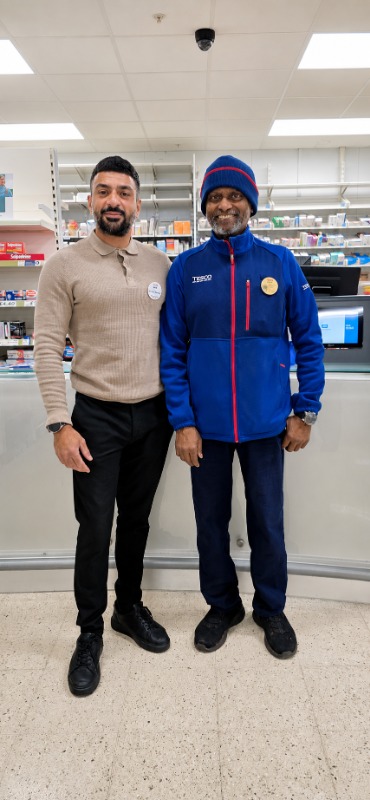
Carlton was subsequently diagnosed with oesophageal cancer at a treatable stage.
"It just felt like the food wasn’t going down properly,” Carlton said: “Because there was no pain or other symptoms, I didn’t think it was anything serious at the time.
“But after finishing a shift one day, I decided to pop over and speak to Nik. He was very thorough - he took the time to ask me a range of questions.
“After that, he told me that something didn’t seem right and that I should get it checked urgently. I went to see my GP that same week and was referred for an endoscopy shortly after. It was during that test that I was diagnosed with cancer.
“Nik encouraging me to get my symptoms checked straight away really made a difference - it gave me the push I needed to take that first step.
“Nik and his team had been doing my prescriptions for years, so I trusted him. I’m really glad I went to speak to him that day - it made all the difference.”
Nik said: “When Carlton came to speak with me, my priority was to listen carefully and take his concerns seriously.
“I had recently completed training on recognising red flag cancer symptoms, which gave me confidence in what to look out for. With that at the front of my mind, I advised him to go and see his GP as soon as possible.
“Carlton’s case highlights how important it is for people to trust their instincts and seek advice from a health professional if something doesn’t feel right. Community pharmacies are there to support, and no concern is too small to talk about. Early conversations can make a real difference, and pharmacists are well placed to support those first steps.”